


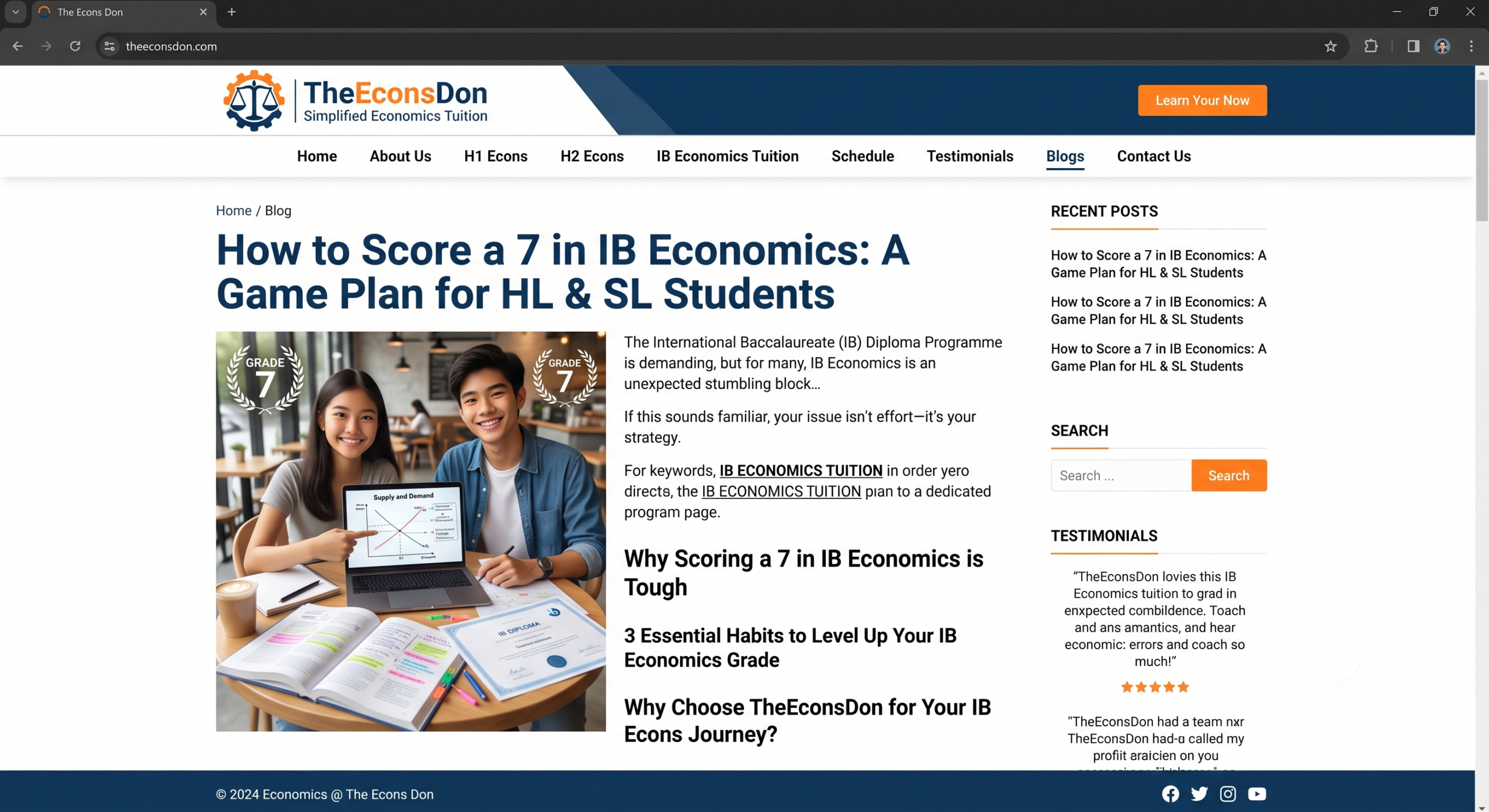
The International Baccalaureate (IB) Diploma Programme is renowned as being very challenging, but for many students, IB Economics is an unwelcome obstacle.
Memorising examples of real world scenarios, drawing a correct diagram in a limited time period, writing a Paper 1 essay and then a data response and writing a policy recommendation in a time span of 40 minutes for Paper 2 and 3 is hard to manage.
The majority of students read books in their textbooks for hours, and get stuck at grade 4 or 5.
If you’ve heard this before, it’s not about how hard you work, it’s about how you work.
The Grade 7 involves more than just memorizing facts and learning to apply them to real-world situations, to diagram and be accurate, and to ask questions in a structured way.
Let’s take a look at the reasons why IB Economics is so difficult, how to overcome this difficulty and how focussed IB economics tuition can help you get those top grades.
Why Is Scoring a 7 in IB Economics So Tough?
The revised IB Economics curriculum curriculum has a strong focus on conceptual understanding (Scarcity, Choice, Efficiency, Equity, Economic Well-Being, Sustainability, Change, Interdependence, Intervention).
There are usually three major impediments that students experience:
Vague Diagrammatic Explanations: Examiners are not only looking for a nice diagram; they are looking for clearly stated step-by-step changes, well-defined axes, market equilibria, and clear connections to the question prompt. For essay questions and/or Paper 2/3 policy discussion, in which everyone receives 15 marks, having a list of advantages and disadvantages is not sufficient and is called Surface-Level Evaluation (CLASPP).
High scorers analyze with a sophisticated perspective (e.g., Consumers, Labour, Assumptions, Short-run vs. Long-run impacts, Priorities of government, Pros & Cons).
In the Internal Assessment (IA) Portfolio: 3 x 800 words commentaries based on current news articles requires exactness in economic terminology and analytical depth within a given word count.
3 Essential Habits to Level Up Your IB Economics Grade
1. Build a “Real-World Example” Bank
For Paper 1 and Paper 2, examiner reports consistently penalize hypothetical or outdated examples. Instead of generic scenarios, build a concise digital cheat-sheet categorized by syllabus topics:
- Negative Externalities of Consumption: Minimum pricing on alcohol in Scotland or sugar taxes in the UK.
- Monetary Policy: Central bank interest rate decisions (e.g., US Federal Reserve, ECB) tackling post-pandemic inflation.
- Trade Protectionism: Specific tariff disputes or export subsidies within key trading blocs.
2. Follow the “DEED” Framework for Extended Responses
Whenever you answer 10-mark or 15-mark questions, use a repeatable structure:
- D – Define: State key syllabus terms clearly and accurately.
- E – Explain: Walk through the underlying economic mechanism step-by-step.
- E – Exemplify & Diagram: Draw a fully labeled diagram and tie it to a real-world context.
- D – Decide / Evaluate: Provide reasoned balance, addressing trade-offs, stakeholder conflicts, and long-term implications.
3. Treat the IA as Your Safety Net
Your IA portfolio accounts for 20% (HL) or 30% (SL) of your final grade. Because it is non-timed, it represents marks you can control before entering the exam hall. Choose news articles that present a distinct, single problem with clear policy solutions to keep your focus sharp and analytical.
How Specialized IB Economics Tuition at TheEconsDon Makes the Difference
Self-study can take you far, but targeted coaching provides the exam intuition and feedback loops necessary to reach the highest grade boundaries.
At TheEconsDon, our specialized IB economics tuition is engineered specifically around the assessment criteria of the International Baccalaureate:
- Taught by Top-Scoring IB Alumni: Founded by Mr. Don Chng—an ACS (Independent) alumnus who scored 43/45 in the IB exams (including a 90/100 Distinction in Economics) and NUS Business graduate—our curriculum is built by someone who has mastered the exact same exams.
- Proprietary Critical Thinking Frameworks: We demystify abstract macroeconomic models and international trade theories using first-principles thinking, giving you repeatable frameworks to tackle unfamiliar case studies.
- Comprehensive IA Support: Receive structured guidance on article selection, diagram presentation, and rubric-aligned commentary drafting.
- Small Class Sizes & Instant Feedback: With capped class sizes (online and in-person in Singapore), students receive personalized essay vetting, timed practice drills, and round-the-clock WhatsApp support for burning revision questions.
Don’t Leave Your Final Grade to Chance
Whether you are an SL student looking for conceptual clarity or an HL candidate aiming for a 7 to secure your conditional university offer, the right guidance turns stress into strategy.
Visit TheEconsDon to learn more about our upcoming IB economics tuition schedules, diagnostic assessments, and trial sessions.



Leave a Reply